What the Navy taught me about leadership
When people hear that I served in the Royal Australian Navy, they often assume the biggest lessons were about discipline, following orders, and maintaining high standards.
While those things certainly have their place, the most valuable lessons I learned were actually about leadership.
At the time, I probably didn't fully appreciate it, considering I joined when I was 17. Looking back now, after working across hospitality, education, and business management, I can see just how much my time in the Navy shaped the way I lead people today.
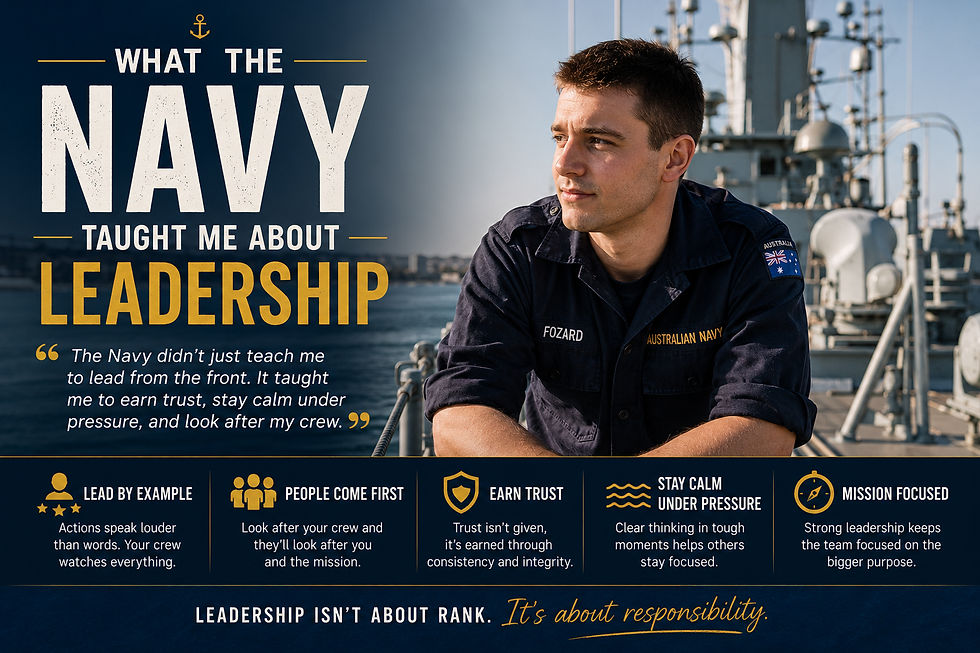
One of the first lessons I learned was that leadership is not about rank. A title may give someone authority, but it does not automatically earn respect. There is a saying in the Defence and Police Forces, as well as any service where there is rank, "You may not respect the person, but you must respect the rank". The leaders who made the greatest impression on me were not always the most senior. They were the people who led by example, remained calm under pressure, and were willing to do the hard work alongside their teams.
I also learned the importance of accountability. In the Navy, people depend on one another. When one person fails to do their job, it affects everyone around them. There is nowhere to hide and no room for passing responsibility. That mindset has remained with me throughout my career. Good leaders take responsibility, especially when things go wrong.
Another lesson was the importance of communication. Whether at sea or in business, uncertainty creates problems. People perform better when they understand the objective, know what is expected of them, and feel comfortable asking questions. Some of the strongest leaders I have worked with were not necessarily the most knowledgeable. They were simply the best communicators.
The Navy also taught me that trust is built through consistency. Teams need to know that their leaders will be fair, reliable, and approachable. Trust is not established through speeches or policies. It is built through everyday actions and decisions.
Perhaps the most important lesson of all was that leadership is ultimately about people. Equipment, processes, and systems are important, but organisations succeed because of the people behind them. Leaders who invest time in understanding their teams, developing their capabilities, and supporting their growth are far more likely to achieve long-term success.
Throughout my career, I have worked in industries that are very different from the Navy. However, the leadership principles have remained remarkably consistent. Whether managing a team in hospitality, supporting students in education, or working with franchise members at Budget Motels, the fundamentals are the same: communicate clearly, lead by example, take accountability, build trust, and put people first.
The older I get, the more I realise that leadership is not about being the smartest person in the room. It is about helping others succeed.
For me, that may be the most valuable lesson the Navy ever taught me.


Comments